 lyns-avenly.com – Hot Local News & Daily Briefs
 lyns-avenly.com – Hot Local News & Daily Briefs
The International Space Station (ISS) has a new resident, and India is celebrating! Shubhanshu Shukla has become the first Indian to board the ISS, joining the Axiom-4 mission crew. This marks a significant milestone for India's space program.
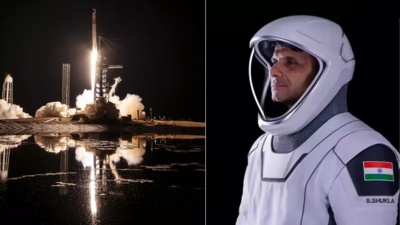
Shukla's arrival follows the successful docking of the Grace spacecraft, the fifth in the Dragon series, with the ISS. The docking occurred over the North Atlantic Ocean. This event signifies a monumental moment nearly four decades after Rakesh Sharma's pioneering space journey in 1984. Joining Shukla on this mission are Slawosz Uznanski-Wisniewski, representing Poland's return to space after a 45-year hiatus, and Tibor Kapu, Hungary's first astronaut in 45 years. The crew launched from NASA's Kennedy Space Center.
India is making strides in its space program with the Gaganyaan mission, an indigenous human spaceflight program slated for launch by 2027. This ambitious project aims to place India among the elite nations—including Russia, the United States, and China—that have independently achieved manned space missions.
Shukla's experiments on the Axiom-4 mission are strategically designed to contribute directly to the Gaganyaan program. His research delves into the effects of microgravity on various factors, including plant growth, muscle loss, mental health, and microbial behavior. These are critical aspects for ensuring the success of long-term human spaceflight. Furthermore, he is studying tardigrades to gain insights into survival mechanisms under extreme conditions.
The goal of these experiments is to develop sustainable space food systems, safeguard astronaut well-being, and enhance life support strategies for future Indian space endeavors.
India and NASA are collaborating on the NISAR (NASA-ISRO Synthetic Aperture Radar) satellite, a $1.5 billion Earth-observing mission scheduled for launch in July from India's Satish Dhawan Space Centre. This advanced satellite will employ high-precision radar to monitor Earth's surface changes continuously, providing invaluable data for agriculture, climate studies, natural disaster management, and more.
Unlike many Earth-observing satellites that are limited by daylight and weather conditions, NISAR utilizes advanced radar technology to provide 24/7, all-weather imaging capabilities. This will enable more consistent and precise monitoring of environmental changes, natural disasters, and agricultural trends.
NISAR's global applications position it as a potential game-changer for scientists, farmers, and disaster response teams worldwide.
Newer articles
Older articles

 WWE: Piper Niven stuns Charlotte Flair in shocking SmackDown upset of 2025
 IRCTC Launches AI Chatbot 'AskDisha 2.0' for Seamless Train Ticket Booking, Refunds & Information
 Hair Oil vs. Hair Serum: Which is the Right Choice for Your Hair?
Alternatively:
Unlock Your Best Hair: Choosing Between Hair Oil and Serum for a Healthy Mane
Hair Oil vs. Hair Serum: Which is the Right Choice for Your Hair?
Alternatively:
Unlock Your Best Hair: Choosing Between Hair Oil and Serum for a Healthy Mane
 Google Unveils Strategy to Combat Misinformation, Boost Voter Access in India's 2024 Elections
 India Enters New Space Age as Astronaut Shukla Joins ISS Mission
 X Cracks Down: Half a Million Indian Accounts Suspended for Policy Breaches
 Vijay Sethupathi Apologizes Amid Controversy Over Son's Film 'Phoenix'
 New York Assemblyman Zohran Mamdani's Style: 5 Lessons in Authenticity and Heritage
 Colon Cancer: Don't Ignore These 5 Early Warning Signs
 Bollywood's 'Swades' Anthem Joins Axiom-4 Mission: Indian Astronaut's Playlist Honors Heritage in Space